

In early 2026, the UK government published its most significant road safety policy document in over a decade. The Road Safety Strategy sets out an ambitious target — a 65% reduction in road casualties and serious injuries on Great Britain’s roads by 2035, alongside a 70% reduction in casualties and serious injuries among children under 16. To achieve these goals, the strategy introduces a sweeping set of reforms covering driver behaviour, vehicle safety technology, road design, and the legal framework governing motoring offences.
For anyone who uses UK roads — whether as a driver, passenger, cyclist, motorcyclist, or pedestrian — these changes matter. But their significance extends beyond road safety alone. The reforms are already reshaping the landscape for personal injury claims arising from road traffic accidents, affecting how liability is established, how evidence is assessed, and what compensation victims of road accidents can expect to receive. This guide explains what the strategy involves, why it matters for accident claims, and what you should know if you have been injured on a UK road.
What Is the UK Road Safety Strategy 2026?
The Road Safety Strategy is a government framework setting out how the UK intends to reduce the human and economic cost of road collisions over the next decade. Published by the Department for Transport, it adopts what is known as the Safe System approach — a methodology widely used across Scandinavia and increasingly adopted globally — which recognises that human error is inevitable and that road systems must therefore be designed to prevent errors from resulting in death or serious injury.
The strategy is structured around five interconnected pillars: safe roads, safe speeds, safe vehicles, safe road users, and post-crash care. Each pillar contains specific policy commitments, consultations, and legislative proposals. Taken together, they represent the most comprehensive rethink of UK road safety policy since the introduction of the Highway Code updates in 2022.
Why the strategy matters now
Despite decades of progress, road traffic collisions remain a leading cause of serious injury in the UK. The Department for Transport’s road accident statistics consistently record tens of thousands of casualties each year, with vulnerable road users — pedestrians, cyclists, and motorcyclists — disproportionately represented among those seriously hurt. The strategy acknowledges that progress has stalled in recent years and that a more systematic, evidence-based approach is needed to drive further reductions.
The Safe System Approach and What It Changes
The Safe System approach, which sits at the heart of the 2026 strategy, represents a fundamental shift in how road safety is understood. Rather than placing responsibility solely on individual road users to avoid error, the Safe System distributes responsibility across road designers, vehicle manufacturers, legislators, and enforcement agencies. The core premise is that no road death or serious injury is inevitable — each one represents a failure of the system, not merely of the individual involved.
Safe roads and speed management
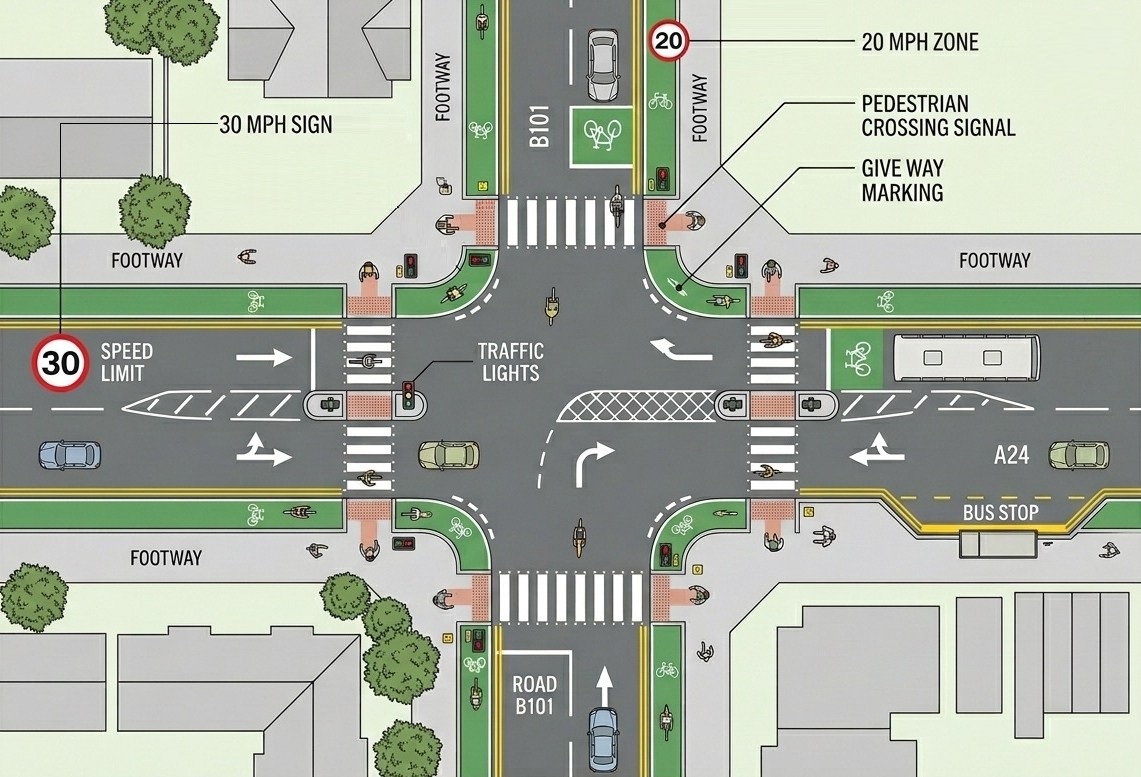
Under the strategy, new design standards are being developed for UK roads that prioritise physical separation of vulnerable road users, reduced vehicle speeds in high-risk areas, and improved junction design. Local authorities are being given clearer guidance and, in some cases, additional powers to implement 20mph zones in residential and high-pedestrian areas. The strategy also commits to a review of existing speed limits on rural A-roads, where a disproportionate number of fatal and serious injury collisions occur.
For personal injury claimants, road design and speed management changes are relevant because they affect how courts assess contributory negligence. Where a collision occurs on a road that demonstrably fails to meet the updated design standards, or in a location where speed management measures were recommended but not implemented, this may be relevant to arguments about shared liability between the driver and the highway authority.
Post-crash care and rehabilitation
The strategy places new emphasis on the quality and speed of post-crash response, including improvements to emergency medical care at the roadside and faster access to rehabilitation for seriously injured road users. For accident victims, this pillar of the strategy is directly relevant to their recovery and, by extension, to the special damages element of their compensation claim. Where delays in post-crash care are found to have worsened a claimant’s injuries or prolonged their recovery, this may give rise to additional heads of loss that should be captured when valuing the claim. Our complete guide to personal injury claims in the UK explains in detail how special damages are calculated and what financial losses can be included in a claim.
New Vehicle Safety Technologies and Their Impact on Claims
One of the most significant elements of the 2026 Road Safety Strategy is its focus on vehicle safety technology. The government has launched a formal consultation on mandating 18 new safety technologies across new vehicles sold in the UK — a process aligned with, but not identical to, the European General Safety Regulation that came into force across the EU in 2022. The technologies under consideration include autonomous emergency braking, intelligent speed assistance, lane-keeping assistance, driver drowsiness detection, reversing detection systems, and event data recorders.
How vehicle technology is changing the evidence landscape
The proliferation of onboard safety technology is having a profound and growing impact on how road traffic accident claims are investigated and litigated. Modern vehicles increasingly carry event data recorders — sometimes referred to as black boxes — that capture speed, braking, steering input, and other parameters in the seconds before a collision. Where such data exists, it provides objective evidence that can either support or undermine a claimant’s account of how an accident occurred.
Similarly, the presence or absence of functioning safety systems is becoming a material issue in liability disputes. Where a vehicle was equipped with autonomous emergency braking that failed to activate, or where a manufacturer’s safety system was found to be defective, this may create a product liability claim alongside or instead of a negligence claim against the driver. These are complex legal arguments that require specialist input, but they represent an increasingly important dimension of serious road accident litigation.

Dashcam and digital evidence
The strategy also acknowledges the growing role of dashcam footage, CCTV, and mobile phone data in road accident investigations. Police and insurers now routinely request dashcam footage as part of the claims process, and courts have demonstrated a willingness to give significant weight to video evidence where it is available and reliable. If you are involved in a road traffic accident, preserving any digital evidence — including dashcam recordings, photographs taken at the scene, and witness contact details — is more important than ever. This evidence can be decisive in establishing liability and securing the compensation you are entitled to receive.
Changes to Motoring Offences and Their Effect on Civil Claims
The Road Safety Strategy includes proposals for strengthening the criminal penalties for dangerous and careless driving, including reform of the offence of causing serious injury by careless driving and a review of sentencing guidelines for fatal collision cases. While criminal proceedings and civil compensation claims follow separate legal tracks, the two are closely connected in practice.
How criminal outcomes affect civil liability
A criminal conviction following a road traffic accident — whether for dangerous driving, drink driving, using a mobile phone, or any other motoring offence — is admissible as evidence of negligence in civil proceedings under the Civil Evidence Act 1968. This means that where a driver has been convicted of an offence arising from the same incident, establishing liability in the personal injury claim is considerably more straightforward. Conversely, an acquittal in criminal proceedings does not prevent a claimant from succeeding in a civil claim, because the civil standard of proof — the balance of probabilities — is lower than the criminal standard of beyond reasonable doubt.
New offences and vulnerable road users
The strategy signals the government’s intention to introduce specific new offences relating to collisions involving vulnerable road users, including pedestrians and cyclists. The 2022 Highway Code updates, which clarified the hierarchy of road users and placed greater responsibility on drivers to protect those more vulnerable than themselves, created a stronger foundation for negligence claims brought by pedestrians and cyclists injured by motor vehicles. The 2026 strategy builds on this by proposing that the Highway Code hierarchy be given greater statutory weight. For vulnerable road users who have suffered serious injuries, this represents a meaningful strengthening of their legal position. You can read more about how the small claims reforms have affected the rights of pedestrians and cyclists in our guide to the personal injury small claims reforms 2026.
What the Strategy Means If You Have Been Injured on a UK Road
If you have been injured in a road traffic accident in 2026 — whether as a driver, passenger, cyclist, pedestrian, or motorcyclist — the Road Safety Strategy is relevant to your claim in several concrete ways. Understanding how the new framework affects your case will help you make better decisions and ensure that no element of your compensation entitlement is overlooked.
Preserve all available evidence immediately
Given the growing importance of digital and technological evidence, your first priority after any road accident should be to preserve every piece of evidence available to you. This means securing dashcam footage before it is overwritten, photographing the scene, the vehicles, and any visible injuries, obtaining the names and contact details of witnesses, and noting the exact location and road conditions at the time of the accident. If the other vehicle was equipped with safety technology that may have activated or failed to activate, make a note of this — your solicitor may need to seek disclosure of the vehicle’s event data as part of the claims process.
Consider whether highway authority liability applies
The Road Safety Strategy’s emphasis on road design and speed management means that highway authority liability — claims against the local council or Highways England for failing to maintain a road to a safe standard — is likely to receive greater attention in personal injury litigation going forward. If your accident was caused or contributed to by poor road conditions, inadequate signage, missing road markings, or a dangerous junction layout that had been flagged as a known hazard, this may support an additional or alternative claim against the highway authority. The National Highways guidance for road users sets out reporting obligations and responsibilities that are relevant to such claims.
Understand how the reforms interact with your claim type
The Road Safety Strategy does not operate in isolation — it interacts with the wider personal injury claims framework, including the small claims reforms and fixed tariff compensation rules for low-value RTA claims. For serious injury cases, the strategy’s emphasis on vehicle technology and highway authority accountability opens up new avenues for establishing liability and maximising compensation. For lower-value claims, the portal process remains the primary route, though the evidential changes introduced by the strategy — particularly around digital evidence — apply equally to claims of all sizes.

Getting the Right Legal Advice After a Road Accident
The Road Safety Strategy 2026 signals a period of significant change in how road safety is regulated and how road accident claims are handled in the UK. For accident victims, the changes are broadly positive — stronger legal protections for vulnerable road users, greater availability of objective evidence, and a clearer framework for highway authority and product liability claims. But navigating these developments requires specialist legal knowledge, particularly as the interaction between new safety technology, reformed offence provisions, and evolving case law continues to develop.
If you have been injured in a road traffic accident and are considering making a compensation claim, speaking to a specialist personal injury solicitor at the earliest opportunity will ensure that all potential heads of liability are properly investigated and that no element of your loss is left unclaimed. For guidance on how to identify the right legal representation for your specific circumstances, our guide on how to choose the right injury attorney sets out the key questions to ask and the qualifications to look for. And if your injuries were sustained at work rather than on a public road, our workplace injury claims guide covers the separate framework of employer liability that applies in those cases.
Road accidents change lives. The law exists to ensure that those who are injured through no fault of their own are not left to bear the consequences alone — and the 2026 Road Safety Strategy, for all its complexity, is ultimately aimed at the same goal.

